
PERSPECTIVES
A monthly essay by Ashley Johnson exploring horses, performance, leadership, and the moments that shape us.
At the Start Box
September 2026
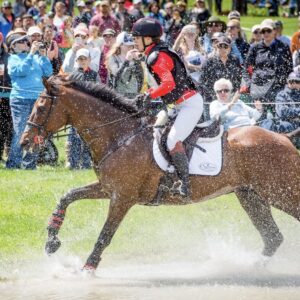
It was a bright spring day. The sunlight had that angular feeling characteristic of the days when winter gives way to the milder months – cheerful but not quite warm yet. There was an easy breeze and the grass was lush. It had a spring to it that I felt beneath Gucci’s feet. I knew my stud choice was good. The announcer blared, and the energy was electric. It was cross country day at the Kentucky five-star.
As I moved Gucci, my bay thoroughbred partner of seven years, around the warm-up field, I felt my own tension. As he trotted, the up-and-down movement of my posting – something I had done a thousand times before – felt more mechanical and disconnected. I took three deep breaths, but the tension did not break. As a five-star rider, I had been in high-pressure situations plenty of times before. I had learned that in these moments my mind would often hijack the task at hand to fantasize about easy days and quiet moments, like reading a book while lying on a beach. It was an irony. I actually dislike reading on the beach, but in that moment, my mind was looking for an escape.
I re-centered my focus. I knew Gucci needed me. He was quick like a cat and an incredibly capable cross-country horse, but when he performed, he did so for his own joy. The crowds and the atmosphere of big horse shows were a distraction to him. I stepped into the canter, asking Gucci to lower his head and relax over his back. While a typical cross-country warm-up might have several jumps in a line, prompting the rider to jump something smaller before moving on to the bigger fences, this warm-up had jumps scattered all around it. There were tables, brush jumps, skinny jumps and corners placed in different locations across the hilly terrain. Although the warm-up space was tucked away in a quiet area, it was still busy. A handful of other competitors were warming up. Volunteers, stewards, coaches, grooms, and bystanders stood on foot in small clusters.
Normally with Gucci, I knew exactly what my jump sequence would be to prepare us for the big, technical cross-country course that awaited us. I would trot a small jump, thinking about my own center of balance while reading his. This was always a check-in on our partnership. After that I would canter a medium-sized jump two or three times to let Gucci warm his body up without adding intensity.
Intensity was Gucci’s middle name.
The longer I could leave it out of our warm-up, the more relaxed he would be going out on course. Finally, when we had our rhythm, I would catch some of the bigger tables and jump a skinny or two. Once Gucci had his mind on the job, there was nothing that would stop him. Our warm-ups were less about preparation and more a place to find this space together.
On this day, I had to make a new plan.
There were no small jumps. In fact, there were no medium-sized jumps either. There was one rolltop in the middle of the field that everyone was starting with. My coach, Australian Olympic rider Clayton Fredericks, stood patiently near the fence line. At that level, your coach is not there to run your warm-up. I knew what I needed to do and what feel I needed to find before we went on course. I wanted Clayton there to make the extraordinary environment feel more normal. We would do just what we had done at home for the weeks, months and years prior. We would find a shape; we would jump the jump.
I trusted Clayton completely. In my career with Gucci, there had been many ups and downs. People had told me I should sell him because I needed a better horse. Gucci could be very fractious in dressage and was frequently a one-rail horse in show jumping. At the time, this was disheartening. It was hard to feel the judgement of the outside world. Clayton, too, in his own way, had tried to direct me towards horses that might be more competitive. For my part, there was no horse in the world that felt like Gucci on cross country. When we were in our element together, it was like touching the stars. Clayton never doubted this. He always took what we showed up with and helped me make it better. He would say to me, “You can’t change who this horse is.” He let Gucci be Gucci.
I jumped the rolltop. Our pace was too slow. I jumped it again. I put Gucci into a tight distance. I jumped it a third time adequately, but my body still felt stiff. The clock was pressuring me. I had ten minutes before my start time. Gucci was a horse who needed to go to the start box directly from warm-up. Stopping and taking a break was not good for him. Even though I had not yet found my feel over the rolltop, I moved on to another table. I jumped a few more fences. They felt adequate. I swung around to the corner. We came to an awkward distance. Gucci stopped. This horse never stopped. My head was screaming. I had just a few minutes to go before one of the biggest and most technical courses of my career, and my horse just stopped in warm-up. Was he ok? Was there something wrong? Why weren’t we finding our rhythm? What if I took Gucci out on course and let him down?
Clayton stepped in.
He directed me to jump the jump again. He coached me in the same way he did at home – pick Gucci’s shoulder up and flow to the jump. He told me to jump a few more jumps. Then he called me over. “Ashley,” he said, “you are going to go out there and pick your way around. Jump one jump at a time and just pick your way around.”
I felt relief in his words. A reminder.
I didn’t have to worry about the long route or the short route at the hollow just yet. I had to do jump one, jump two, jump three. I had to sit up and ride the log in at the duck pond water at jump four. Keep my leg on. I just had to ride what was in front of me. Then he said words I will never forget. “Whatever happens out there today is going to make you a better rider for the future.” Something in those words made everything O.K. Clayton believed in me. I was there to learn. There would be a future. My job was to stay present, and to ride my horse.
We left the start box. Gucci jumped clear, and on that day, we touched the stars.
Years later, that moment still impacts me. In a moment when I was consumed by the significance of what was about to happen, a good coach made the outcome smaller. He reminded me that this one performance did not have to prove anything about who I was or what I might become. Whatever happened, there would be something on the other side of it. There would be a future. Perhaps that is one of the greatest gifts a coach can give us – not the certainty that we will succeed, but the freedom to discover what we are capable of when we are no longer afraid of what will happen if we don’t.
Receive the next Perspective → Subscribe here.